Chapter 12: Network Over-Provisioning - Throwing Hardware at the Problem
We know that selfish routing is inefficient. In Pigou’s example, drivers clogged the fast road, making the average travel time 1.0 hour, while a dictator could have achieved 0.75 hours.
How do we fix this?
Central Control: Force people to take specific routes (Hard, unpopular).
Tolls: Charge money for the fast road (Complex to implement).
Over-Provisioning: Just build wider roads or buy faster servers.
The Theory of Resource Augmentation
In the tech industry, hardware is often cheaper than software complexity. Google and AWS often run their networks at low utilization to ensure speed.
The Key Theorem:
If you double the speed (capacity) of every link in your network, the Selfish Outcome becomes at least as good as the Optimal Outcome of the original network.
In other words: 2x Hardware + Selfish Users 1x Hardware + Perfect Management.
Let’s test this “Brute Force” strategy with code.
import numpy as np
import matplotlib.pyplot as plt

def compare_capacities():
    """
    Compares:
    1. Optimal Routing (Original Network)
    2. Selfish Routing (Original Network)
    3. Selfish Routing (Double Capacity Network)
    """

    # --- SCENARIO 1: ORIGINAL NETWORK (Capacity 1x) ---
    # Path A: Latency = x (Linear congestion)
    # Path B: Latency = 1 (Constant)
    # Total Traffic = 1.0

    # We know from Chapter 11:
    # Optimal Split: 50/50.
    # Optimal Cost: 0.5*0.5 + 0.5*1 = 0.75
    opt_cost_original = 0.75

    # Selfish Split: 100% take Path A.
    # Selfish Cost: 1.0 * 1.0 = 1.0
    nash_cost_original = 1.0

    # --- SCENARIO 2: UPGRADED NETWORK (Capacity 2x) ---
    # "Doubling Capacity" means Latency is HALVED for the same load.
    # Path A: Latency = x / 2
    # Path B: Latency = 1 / 2

    # New Selfish Equilibrium Calculation:
    # Drivers take Path A until Cost(A) = Cost(B)
    # x / 2 = 1 / 2
    # x = 1.0
    # Equilibrium: 100% take Path A.

    # Calculate Cost:
    # Traffic x = 1.0.
    # Latency = 1.0 / 2 = 0.5
    nash_cost_upgraded = 1.0 * 0.5

    # --- RESULTS ---
    print(f"--- Resource Augmentation Analysis ---")
    print(f"1. Original Network (Perfect Management): Cost = {opt_cost_original}")
    print(f"2. Original Network (Selfish Users):      Cost = {nash_cost_original}")
    print(f"3. Upgraded Network (Selfish Users):      Cost = {nash_cost_upgraded}")

    print(f"\nComparison:")
    if nash_cost_upgraded <= opt_cost_original:
        print(f"SUCCESS: The upgraded selfish network (0.5) beat the original optimal one (0.75)!")
    else:
        print("FAIL: Adding hardware wasn't enough.")

    # --- VISUALIZATION ---
    labels = ['Optimal (1x)', 'Selfish (1x)', 'Selfish (2x Speed)']
    values = [opt_cost_original, nash_cost_original, nash_cost_upgraded]
    colors = ['green', 'red', 'blue']

    plt.figure(figsize=(8, 5))
    bars = plt.bar(labels, values, color=colors, alpha=0.7)

    # Add text labels
    for bar in bars:
        yval = bar.get_height()
        plt.text(bar.get_x() + bar.get_width()/2, yval + 0.02, round(yval, 2), ha='center', fontweight='bold')

    plt.ylabel("Total Network Latency (Lower is Better)")
    plt.title("Can Hardware Fix Selfishness?")
    plt.ylim(0, 1.2)
    plt.show()

compare_capacities()
--- Resource Augmentation Analysis ---
1. Original Network (Perfect Management): Cost = 0.75
2. Original Network (Selfish Users): Cost = 1.0
3. Upgraded Network (Selfish Users): Cost = 0.5
Comparison:
SUCCESS: The upgraded selfish network (0.5) beat the original optimal one (0.75)!
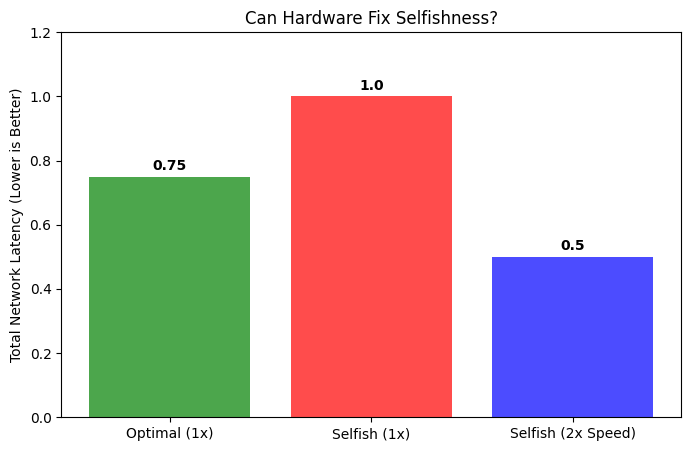
Analysis: Hardware vs. Management
The results are clear:
Original Optimal: 0.75
Upgraded Selfish: 0.50
By simply doubling the bandwidth, the “dumb” selfish outcome became better than the mathematically perfect outcome of the old system.
Why is this important for Engineering? This explains why “Over-Provisioning” is a dominant strategy in network architecture.
Designing complex protocols to enforce optimal routing is expensive and fragile.
Buying 2x more fiber optic cable or 2x faster CPUs is easy and robust.
The Takeaway: If the Price of Anarchy is low (like 4/3), you don’t need to change human behavior. You just need slightly better infrastructure.