Chapter 11: The Price of Anarchy - How Much Does Selfishness Cost?
We previously saw Braess’s Paradox, where selfish drivers created traffic. But can we measure exactly how inefficient selfish behavior is?
The Metric: Price of Anarchy (PoA)
The Price of Anarchy is a ratio that measures the damage caused by lack of coordination.
If PoA = 1, selfish people are perfectly efficient (Invisible Hand).
If PoA = 2, the selfish outcome is twice as bad as the optimal one.
Pigou’s Example
This is the “Hello World” of Selfish Routing. Imagine 1 unit of traffic wants to go from Start to End.
Route 1 (Top): Very fast, but gets easily clogged. Cost = (where is the % of traffic).
Route 2 (Bottom): Slow but infinite capacity. Cost = 1 (constant).
The Selfish Outcome (Nash Equilibrium):
Drivers look at Route 1. If , the cost is less than 1.
Route 2 costs 1.
Therefore, everyone takes Route 1 until the cost reaches 1.
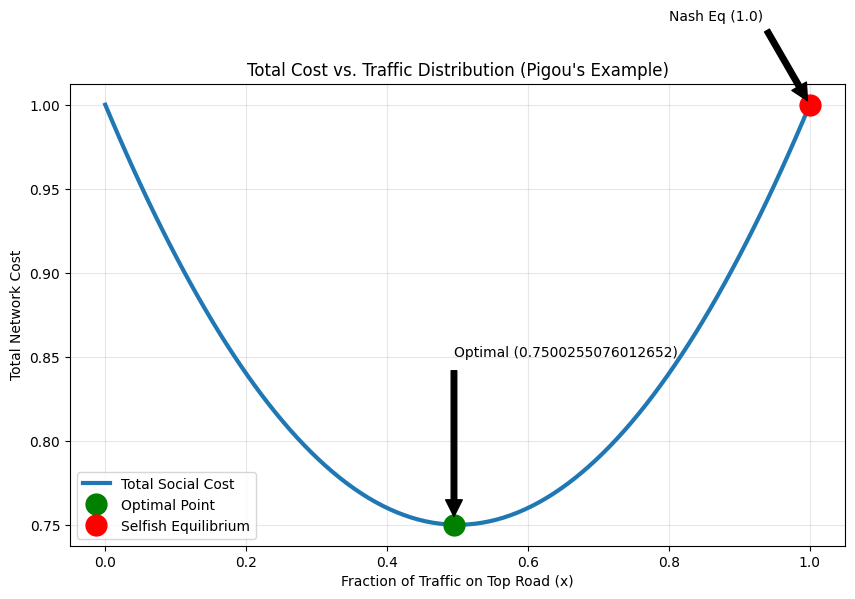
Result: 100% of drivers take Route 1. Everyone pays 1 hour. Total Cost = 1.
The Optimal Outcome:
A benevolent dictator would split the traffic to minimize total latency.
Let’s calculate the perfect split with Python.
import numpy as np
import matplotlib.pyplot as plt

def solve_pigou_example():
    """
    Simulates Pigou's Example to find the Price of Anarchy.
    Total Traffic = 1.0
    Path 1 Cost: C(x) = x
    Path 2 Cost: C(y) = 1
    """

    # 1. DEFINE COST FUNCTIONS
    # Total Cost = (Traffic on 1 * Cost of 1) + (Traffic on 2 * Cost of 2)
    def total_social_cost(x):
        # x is traffic on Path 1
        # (1-x) is traffic on Path 2

        time_path_1 = x          # Cost is proportional to load
        time_path_2 = 1.0        # Constant cost

        # Total latency experienced by all drivers
        return (x * time_path_1) + ((1 - x) * time_path_2)

    # 2. FIND OPTIMAL SPLIT (Minimizing Total Cost)
    # We check values of x from 0 to 1
    x_values = np.linspace(0, 1, 100)
    costs = [total_social_cost(x) for x in x_values]

    min_cost = min(costs)
    optimal_x = x_values[np.argmin(costs)]

    # 3. FIND SELFISH SPLIT (Nash Equilibrium)
    # Drivers switch to Path 1 as long as Cost(1) < Cost(2)
    # Cost(1) = x. Cost(2) = 1.
    # Equilibrium happens when x = 1 (or costs equalize).
    # Since max x is 1, and at x=1, Cost(1)=1 which equals Cost(2),
    # the equilibrium is x = 1.

    selfish_x = 1.0
    selfish_cost = total_social_cost(selfish_x)

    # 4. CALCULATE PRICE OF ANARCHY
    poa = selfish_cost / min_cost

    print(f"--- Pigou's Example Results ---")
    print(f"Socially Optimal Traffic on Top Road: {optimal_x:.2f} (50%)")
    print(f"Socially Optimal Cost: {min_cost:.2f}")
    print(f"\nSelfish Traffic on Top Road: {selfish_x:.2f} (100%)")
    print(f"Selfish Cost: {selfish_cost:.2f}")
    print(f"\nPrice of Anarchy (PoA): {poa:.4f} (Exactly 4/3)")

    # 5. VISUALIZATION
    plt.figure(figsize=(10, 6))
    plt.plot(x_values, costs, label='Total Social Cost', linewidth=3)

    # Mark Optimal
    plt.plot(optimal_x, min_cost, 'go', markersize=15, label='Optimal Point')
    plt.annotate(f'Optimal ({min_cost})', xy=(optimal_x, min_cost), xytext=(optimal_x, min_cost+0.1),
                 arrowprops=dict(facecolor='black', shrink=0.05))

    # Mark Selfish
    plt.plot(selfish_x, selfish_cost, 'ro', markersize=15, label='Selfish Equilibrium')
    plt.annotate(f'Nash Eq ({selfish_cost})', xy=(selfish_x, selfish_cost), xytext=(selfish_x-0.2, selfish_cost+0.05),
                 arrowprops=dict(facecolor='black', shrink=0.05))

    plt.title("Total Cost vs. Traffic Distribution (Pigou's Example)")
    plt.xlabel("Fraction of Traffic on Top Road (x)")
    plt.ylabel("Total Network Cost")
    plt.legend()
    plt.grid(True, alpha=0.3)
    plt.show()

solve_pigou_example()
--- Pigou's Example Results ---
Socially Optimal Traffic on Top Road: 0.49 (50%)
Socially Optimal Cost: 0.75
Selfish Traffic on Top Road: 1.00 (100%)
Selfish Cost: 1.00
Price of Anarchy (PoA): 1.3333 (Exactly 4/3)
Analysis: The Magic Number 4/3
The simulation reveals a specific number: 1.333... or 4/3.
Optimal: Drivers should split 50/50. Half take the fast road (cost 0.5), half take the slow road (cost 1). Average = 0.75.
Selfish: Everyone takes the “fast” road. But because 100% of people take it, it slows down to cost 1. Average = 1.
The Theorem: In this chapter’s lecture notes, we prove that for any network with linear latency functions (like ), the Price of Anarchy is never worse than 4/3.
This is good news! It means that in simple networks, selfish behavior is “good enough.” We only lose about 33% efficiency compared to a central dictator.